
Posted at: November 24, 2026
The Gift of More Tomorrows: Dr. Doug Graham's Vision for Innovation, Discovery and Philanthropy
The Gift of More Tomorrows: Dr. Doug Graham's Vision for Innovation, Discovery and Philanthropy
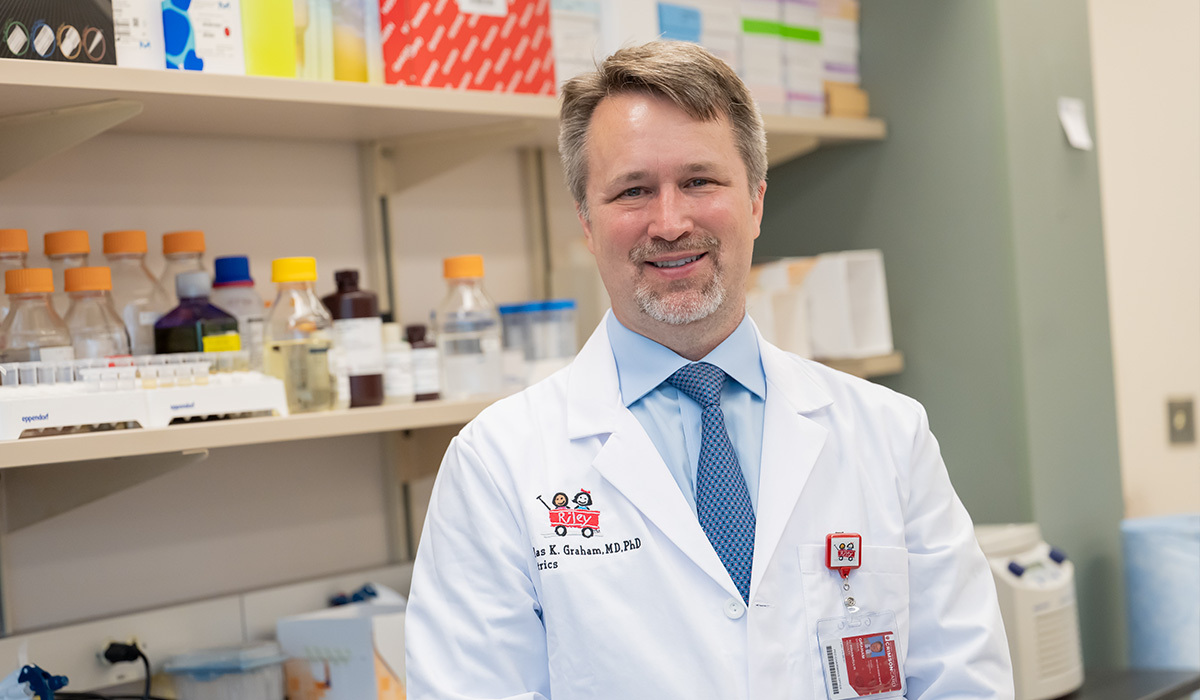
One of the patients who shaped Dr. Doug Graham's career wasn't remembered for the treatments he received. He was remembered for the gifts he gave away.
The teenager was battling leukemia. After years of treatment, Graham and his care team had exhausted every option. As the young man's life neared its end, he was granted a wish. Instead of asking for a trip or a special experience, he requested dozens of gift cards.
At first, Graham admits, the request puzzled everyone.
Then they watched as the teenager walked through the hospital, distributing the cards one by one to other children he had met during his cancer journey. Friends from the playroom. Neighbors on the unit. Kids facing battles of their own.
"He wanted to show his appreciation for the friends he had made in the hospital," Graham recalls.
More than 30 years into his career as a pediatric oncologist, the memory remains vivid. Not because it reflected loss, but because it reflected the extraordinary resilience and generosity that children demonstrate every day, even in life's most difficult moments.
For Graham, those lessons also serve as a powerful reminder of why innovation in pediatric medicine matters.
"Our goal," he says, "is to find ways for a child like this to have the opportunity to live a lifetime."
That mission is what drew Graham to Indiana as the new chair of the Indiana University School of Medicine Department of Pediatrics and physician-in-chief at Riley Children's Health.
Building on a Strong Foundation
After helping build nationally recognized pediatric oncology and research programs throughout his career, Graham saw something special in Riley Children’s.
"I was excited to consider an opportunity to join Riley Children's Health," he says. "It's a fantastic program already with incredible providers, nurses, researchers and staff."
What excites him most, however, is not a building or a ranking. It's the people.
"The very best hospitals know how to recruit and retain top talent," he says. "It all starts with exceptional people."
As he begins listening and learning across Riley and the IU School of Medicine, Graham's focus is on partnering with clinical and research leaders to create a shared vision for the future; one that builds on Riley's existing strengths while positioning the health system among the nation's premier pediatric centers.
That future, he believes, depends on bringing scientific discoveries closer to the bedside.
From Discovery to Healing
Riley researchers are already among the nation's best. But Graham sees an opportunity to accelerate how quickly promising discoveries reach children and families.
"We have outstanding research," he says. "Now we need to find more ways to translate those discoveries into clinical trials that improve patient outcomes."
He points to an all-too-common challenge in academic medicine: breakthrough ideas can become stranded between laboratory research and patient care because funding for early-stage clinical development is limited.
Some researchers call it "the valley of death."
It's a place where promising discoveries risk never reaching the children who need them most.
Graham believes philanthropy can help bridge that gap.
Donor support provides critical seed funding that allows researchers to test new ideas, launch investigator-initiated clinical trials and gather the evidence needed to attract larger federal grants. In many cases, a philanthropic investment serves as the catalyst that transforms a laboratory breakthrough into a life-changing treatment.
"In some situations, there simply isn't another funding source available," Graham says. "Philanthropy enables ideas to move directly into clinical trials that can improve patient outcomes."
A New Era of Pediatric Medicine
The timing couldn't be better.
Graham believes pediatric medicine is entering one of the most exciting periods in its history. Advances in genomics, precision medicine, cellular therapies, artificial intelligence and fetal interventions are already changing how children are diagnosed and treated.
He envisions a future where whole genome sequencing helps physicians identify rare diseases earlier, where a child's own immune cells can be trained to fight cancer, and where AI helps clinicians recognize serious illnesses before symptoms become critical.
These innovations are not distant possibilities. They are rapidly becoming realities.
The challenge for leading children's hospitals is creating the infrastructure, expertise and research environment necessary to deliver them. That, too, is where philanthropy plays an essential role.
"Philanthropy doesn't just accelerate a vision," Graham says. "In many cases, it enables that vision to happen."
Investing in More Tomorrows
Beyond research and innovation, Graham sees donor support as critical to developing the next generation of pediatric leaders, physicians and scientists. As Riley expands access to expert care across Indiana and strengthens programs that attract families from across the Midwest and beyond, the need for exceptional talent will continue to grow.
The investments donors make today help recruit world-class experts, train future leaders and ensure children have access to the most advanced care possible close to home.
For Graham, every gift matters.
"Sometimes people think their gift is too small to make a difference," he says. "What we've found is that every dollar can have an impact."
Perhaps that's because meaningful change often begins with a single act of generosity.
A donor's gift. A researcher's idea. A physician's determination.
Or a teenage boy who, in the midst of his own battle, chose to give something away.
It's a lesson Graham carries with him as he begins this new chapter at Riley: when compassion and possibility come together, they create something every child deserves.
More tomorrows.